In order to reduce the risks of floods and major waterlogging, as well as to prevent irreversible changes in nature, in December the Nature Conservation Agency (DAP) began the restoration of Ķemeri National Park’s(ĶNP) hydrological regime in wetlands, where drainage had previously been carried out in a way harmful to the environment.
Restoration of the natural hydrological regime will take place in three places in ĶNP: in Smārde Parish in Engure District and in the parishes of Džūkste and Slampe in Tukums District on properties that belong to the State and are sufficiently far from residential areas. As a result of these works, it is planned to restore natural habitats of EU importance: raised bogs, swamp forests and floodplain meadows.
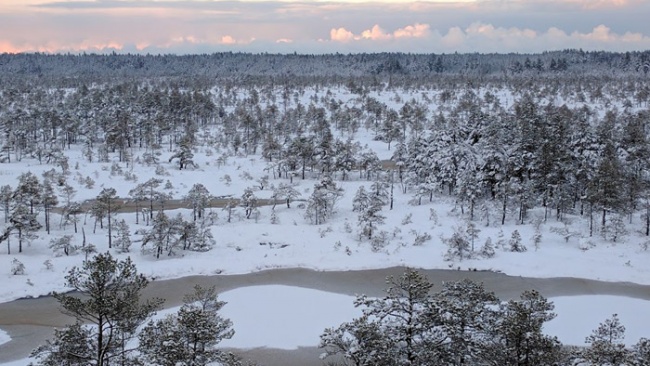
Restoring the natural hydrological regime will eradicate the negative impact of the previously set up drainage system and restore the bog woodland and swamp forest. Natural restoration of the water level will take place in the area of the peat quarries in Zaļais purvs, where the bog has degraded as a result of the extraction of peat and cannot restore itself. The bog is becoming overgrown with forest, while plant species typical of the bog, e.g. sphagnum mosses, cranberries and sundews are disappearing.
Likewise, restoration will also take place in the forests adjoining the western part of the Ķemeri raised bog, which were subject to drainage by installing a network of ditches, as well as on the Skudrupīte, which was straightened out in the 1930s for agricultural purposes. By restoring its winding flow, floodplains will once again stretch out along the banks on the river and serve as an important feeding and rest habitat for migrating birds, as well as home of two endangered bird species – the corncrake and lesser spotted eagle.
“Currently, we face a big and important task – to conserve Latvian wetland territories that are outstanding habitats of European importance, thus reducing the worries of future natural disasters such as floods and major waterlogging. Wetlands not only have an important role as natural sponges during periods of flooding, accumulating waters from spring flooding or heavy rainfall, but also as climate-regulating and natural water purification systems. Therefore it is worth taking care of the conservation and restoration of these sensitive nature areas,” explains the Director of DAP Pierīga Regional Administration Andris Širovs.
The restoration works in Zaļais purvs will be carried out in accordance with the hydrological regime restoration work construction projects developed by SIA “Inženieru birojs “Profecto””, SIA “Ģenerāluzņēmējs”. In turn, on the Skudrupīte river and in the forests adjoining the western edge of the Ķemeri Raised Bog, the works will be carried out by general partnership “Melioratori”. The environmental impact assessment prepared before these works confirms that restoration of the hydrological regime within the territories of ĶNP will not impact surrounding residential or agricultural territories.
Parallel to the major construction works, grazing pastures will be established in the Melnragi grasslands, the project foresees that a 3.8 km long pasture fencing will be built, as well as two viewing platforms, which will soon be available for visitors of ĶNP. These works will be carried out by SIA “Nejss”.
The works are being carried out as part of the LIFE+ project “Restoring the hydrological regime of Ķemeri National Park” (“HYDROPLAN” LIFE10NAT/LV/000160). The project is financed by the European Commission and the Administration of the Latvian Environmental Protection Fund. The project conclusion is planned in 2018, more information on can be found on the project website.
Source: The Nature Conservation Agency