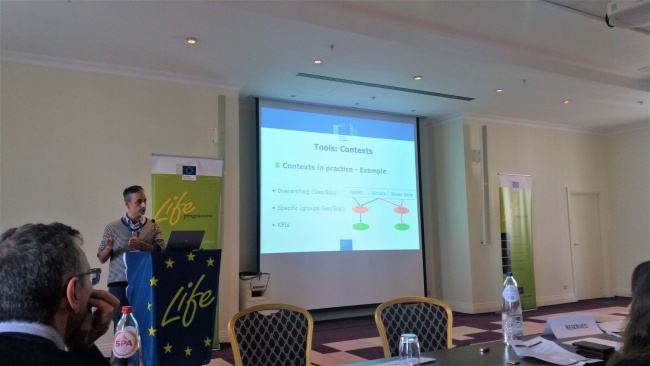
Training was organised by the EC LIFE Programme Unit in cooperation with the Small and Medium Enterprises Executive Agency (EASME), which jointly coordinates the implementation of the LIFE Programme within the EU. Representatives from all EU member states attended the event.
In training, experts from the EC Directorate-General for Environment and Climate explained this year’s priorities in each area, and highlighted the upcoming changes to the programme over the next programming period. Angelo Salsi (Head of EASME LIFE Programme Unit) and Fabio Leone (Head of EASME LIFE Sector) informed the attendees about the results of the 2018draft, as they have changed it, in comparison to other years, and the results of the new two-step application system under the Environment sub-programme.
Special attention was paid to Integrated Projects, their success and their promotion. LIFE Integrated Projects are a relatively new form of projects characterised by a broad territorial dimension, by pooling several sources of funding and by a significant contribution to the implementation of EU environmental and climate policy. The related EU programmes, Horizon 2020 and the European Solidarity Corps, were also highlighted.
EASME experts demonstrated an online system for tracking and evaluating the resulting indicators for projects that are useful for evaluating their activities and for analysing the overall contribution of the LIFE Programme at EU level. The EU’s single eGrant online system has also been demonstrated, adapted so that LIFE project applications can also be included in the future: the system will soon be able to submit technical assistance projects under the verification regime.
In practice, the participants of the training took note of project assessment methods and key principles in the Climate and Environmental sub-programmes, as well as the Integrated Project Assessment Process, which will help experts to advise their national project applicants.
Training of the National Contact Points shall be organised annually to prepare the LIFE Programme for the updates of the individual programme prior to the annual draft draft, to inform about the changes in priorities, and to provide a general insight into the results of the previous draft.